Dydx is a perpetuals trading venue shaped by MegaVault liquidity
In short: Decentralized perpetuals trading platform where self-custody crypto traders manage leveraged positions with up to 50x buying power.
Dydx is a self-custody crypto derivatives exchange for trading perpetual contracts across more than 200 markets, with MegaVault liquidity, advanced order tools, and buying power up to 50x. The narrower angle that matters for active traders is liquidity access: MegaVault supplies automated market depth so new and established markets receive usable order books without every trader waiting for a traditional market maker.
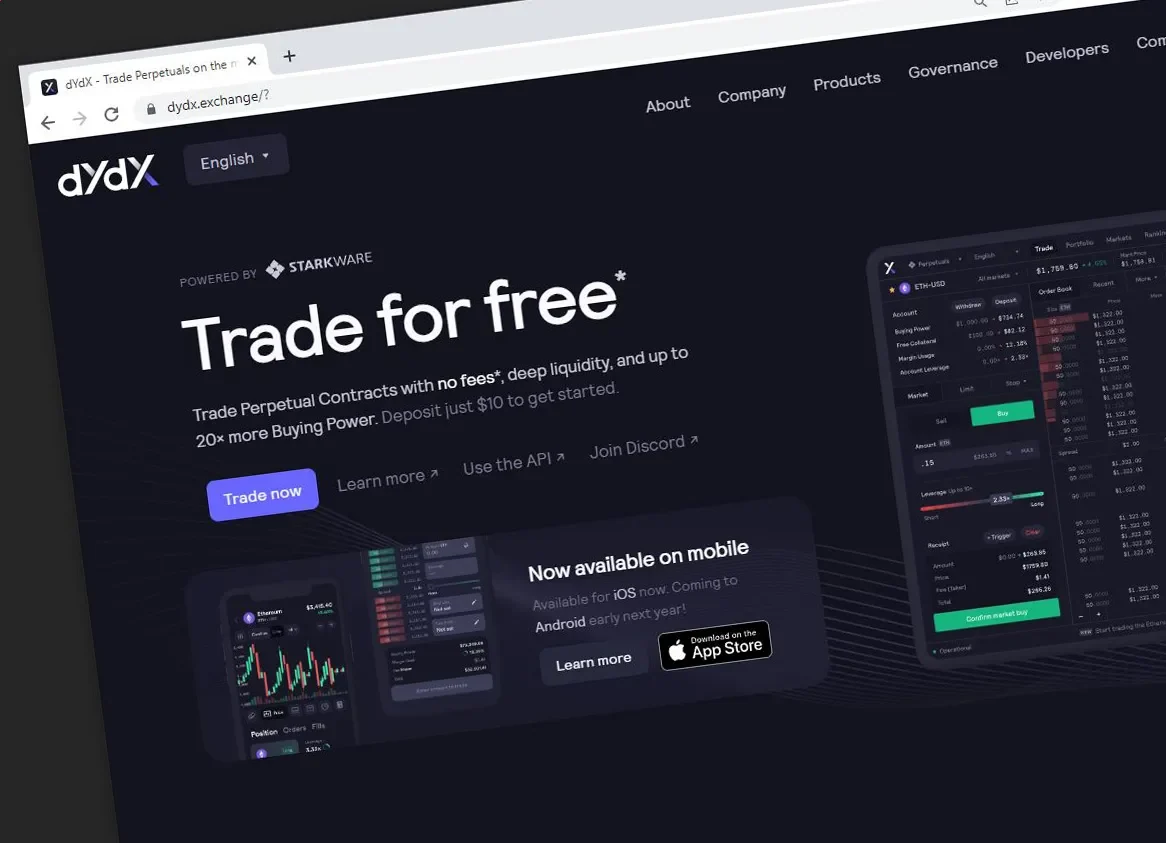
Perpetual contracts are the main product. They track crypto asset prices without an expiry date, so a trader opens long or short exposure, manages margin, and closes the position when the trade plan ends. Dydx focuses on that professional trading flow rather than spot swaps, NFT activity, or passive wallet browsing. Its web and mobile interfaces put account equity, leverage, open positions, orders, and market data in the center of the screen.
MegaVault turns idle capital into market depth
MegaVault is the liquidity feature that separates this trading experience from a simple order-book interface. It aggregates deposited capital and deploys it across markets as automated liquidity. That matters because perpetual markets need counterparties, spreads, and depth before traders treat them as usable. A market with weak liquidity turns every larger order into slippage; a market with deeper liquidity lets entries and exits land closer to the intended price.
The practical appeal is especially clear on newer listings. Dydx supports instant market listings, so the exchange needs a way to make fresh markets tradable quickly. MegaVault helps bridge that first-liquidity gap by backing order books while trading activity develops. The vault is also part of the protocol's broader incentive design, where trading, referral activity, and long-term participation each feed different parts of the ecosystem.
Perpetual markets use margin instead of simple balances
A spot trade exchanges one asset for another. A perpetual position works through margin, unrealized profit and loss, funding, and liquidation thresholds. When a trader opens a BTC, ETH, SOL, or BONK perpetual, the account posts collateral and takes synthetic exposure to price movement. A long position gains when the market rises; a short position gains when the market falls.
Buying power up to 50x changes the math. It lets a smaller collateral balance control a larger notional position, but the liquidation price moves closer as leverage rises. On Dydx, the trader's real job is position sizing: choosing collateral, leverage, stop placement, and order type before volatility makes those choices urgent. The interface gives the tools, while the account owner remains responsible for margin.
Order types fit active execution, not casual swapping
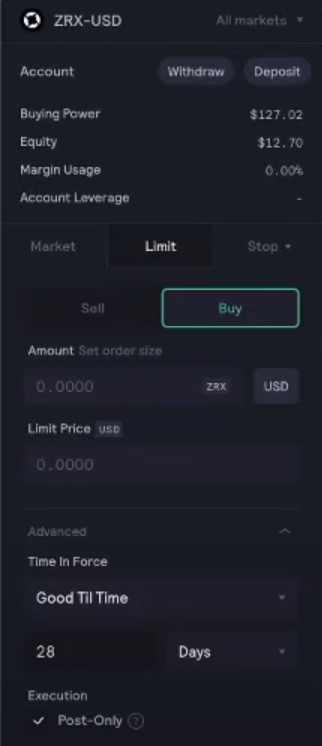
The exchange is built for traders who care about execution. Market orders prioritize immediate fills. Limit orders set a desired price. Stop and take-profit logic helps define exits before the market moves. Reduce-only settings keep an exit order from accidentally flipping a position in the other direction. These details matter in perpetual trading because a single misplaced order changes exposure quickly.
Advanced controls also support team and API workflows. Trading firms and systematic users need order routing, account monitoring, and repeatable execution. Dydx includes API access and pro-grade interfaces for that audience, while the standard app still gives a solo trader the same core order book, chart, collateral, and position controls.
Deposits start from major chains, then trading happens in one account
Funding the account begins with a supported wallet and a deposit route from networks such as Ethereum, Base, Arbitrum, Polygon, Avalanche, and Optimism. The benefit is simple: users bring collateral from familiar ecosystems and then trade multiple perpetual markets from a single trading account. That keeps the workflow closer to a derivatives venue than a chain-by-chain DeFi hunt.
Once funds arrive, the user selects a market, reviews depth and price movement, enters collateral and leverage, and places an order. A clean first session means using modest size, confirming the liquidation price, and setting exits before increasing position complexity. The most expensive beginner mistake is treating buying power as a target instead of a ceiling.
Fees, campaigns, and rewards change the effective cost
Trading cost comes from several places: exchange fees, spread, slippage, funding payments, and liquidation penalties if a position breaches margin requirements. The official fee schedule is the anchor for maker and taker costs, while temporary campaigns change the cost on selected pairs. Dydx has promoted fee-free trading for BTC and BONK during June, showing how campaigns sit on top of the regular trading model.
Rewards are another part of the economic layer. Affiliate payouts, trading incentives, and VIP structures support growth, but they do not replace trade quality. A reward improves the economics of activity that already makes sense; it does not fix a weak setup, oversized leverage, or poor collateral management.
The DYDX token connects governance and the chain economy
The DYDX token is tied to governance and the network economy around the exchange. Token holders participate in decisions that affect parameters, incentives, and the direction of the protocol. The exchange's move into its own app-chain design also reflects a larger DeFi pattern: derivatives venues need fast settlement, predictable infrastructure, and control over the trading stack.
That architecture places the platform near the Cosmos and app-chain conversation, where sovereign chains use specialized infrastructure for a focused purpose. In this case, the purpose is not general smart-contract experimentation. It is high-throughput perpetual trading, with market creation, liquidity, order execution, and incentives arranged around derivatives activity.
Where it fits beside centralized futures exchanges
Centralized futures venues still dominate many professional workflows because they offer broad liquidity, familiar account systems, and integrated fiat services. The decentralized alternative emphasizes self-custody, transparent on-chain settlement, and wallet-based access. The tradeoff is operational: users manage wallets, deposits, signatures, and collateral behavior directly.
That distinction matters most during stress. A self-custody derivatives exchange gives users direct control over assets and account interactions, while centralized venues manage custody and internal balances. Dydx appeals to traders who want perpetual exposure without handing the entire account relationship to a custodian. It is best understood as a trading venue for people already comfortable with crypto wallets, collateral, and risk controls.
A focused workflow for the first serious trade
A disciplined first trade starts before the order ticket. Choose a liquid market, read the order book, inspect recent volatility, and decide the invalidation level. Then set collateral and leverage so liquidation sits beyond the planned stop, not directly behind it. This sequence keeps the position tied to a trade idea rather than to the maximum leverage shown on the screen.
- Pick a major market before experimenting with a thin new listing.
- Use limit orders when entry price matters more than instant execution.
- Set reduce-only exits to avoid unintentionally reversing exposure.
- Track funding because it changes the cost of holding a position.
- Keep enough free collateral to absorb ordinary volatility.
After the position opens, monitoring matters more than clicking around. The account view shows equity, margin usage, open orders, and unrealized profit or loss. Dydx gives experienced users the speed and control they expect from a derivatives screen, while newer users should treat the interface as a place for planned execution, not impulse leverage.
Best fit and realistic alternatives
The platform fits crypto-native traders who want perpetual markets, self-custody, mobile and web access, and a growing set of listed assets. It also fits teams that need API connectivity and referral or affiliate structures around trading volume. MegaVault makes the market-listing angle stronger because liquidity is part of the product design rather than an afterthought.
Alternatives depend on the priority. Hyperliquid is known for a fast on-chain perps experience with its own order-book ecosystem. GMX centers on liquidity pools and oracle-priced leveraged trading. Coinbase Advanced and Binance Futures serve traders who prefer centralized accounts, though custody and access rules differ by region. Dydx belongs in the conversation when the search is specifically for decentralized perpetuals with deep markets, leverage tools, and wallet-based control.
Helpful answers about Dydx
Does Dydx support trading from a mobile phone?
Yes. The trading experience includes mobile access as well as a web interface, so users manage markets, positions, orders, and account balances without staying at a desktop. Mobile trading is best for monitoring and planned execution. Large changes to leverage, collateral, or complex orders deserve extra attention because a small input mistake on a phone changes exposure quickly.
Can US traders use every perpetual market on Dydx?
Access depends on the platform's current eligibility rules and regional restrictions, and US availability has been a recurring issue for decentralized derivatives projects. Perpetual contracts are regulated differently across jurisdictions, so a trader's location matters before any deposit or order. The relevant point is eligibility first, then market selection, then position sizing.
Why does MegaVault matter for newly listed markets?
New perpetual markets need liquidity before they feel usable. MegaVault supplies automated liquidity across markets, helping order books develop depth even when a listing is fresh. That does not remove market risk, but it improves the starting conditions for traders who want tighter execution and for new assets that need more than a listing page.
Is the DYDX token required to place a trade?
A trader does not evaluate the venue only by holding the governance token. The DYDX token is tied to governance and the network economy, while the trading workflow centers on collateral, margin, orders, and market exposure. Token participation matters for users interested in protocol decisions; active trading depends more on funding the account correctly and managing risk.