Dydx is a self-custodied perpetuals exchange built for high-speed crypto contract trading
In short: Decentralized perpetuals exchange for trading crypto contracts with deep liquidity, advanced order types, and up to 50x buying power.
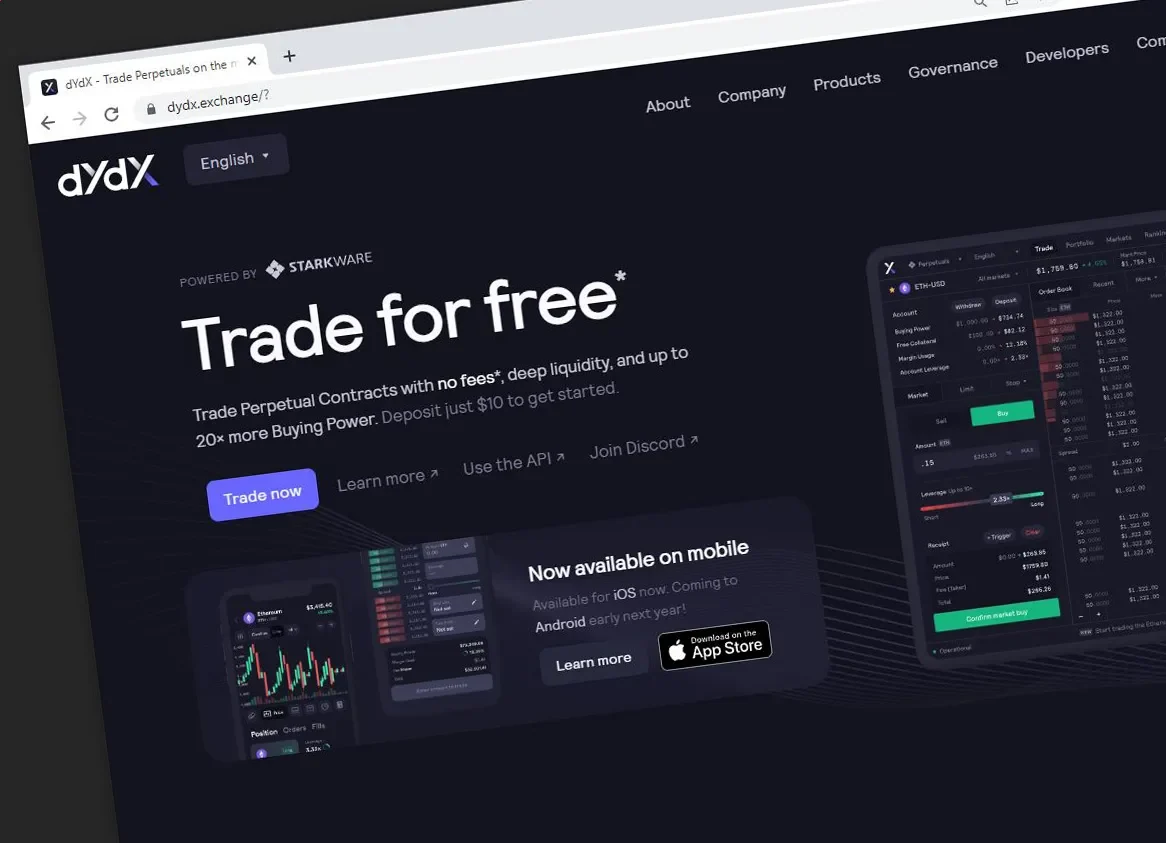
Dydx is a decentralized trading venue for crypto perpetual contracts, where traders open long or short positions with margin while keeping control of their assets. It combines an order book interface, advanced order types, mobile and web access, API connectivity, rewards programs, and up to 50x buying power on supported markets. Its strongest distinction is the dedicated trading infrastructure around perpetuals rather than a general-purpose swap interface.
Perpetual contracts settle on margin, not delivery
A perpetual contract tracks the price of an asset such as BTC, ETH, SOL, or another listed market without requiring delivery of the underlying coin. A trader posts collateral, chooses position size, and manages exposure through margin. The contract stays open until the trader closes it, reaches a liquidation threshold, or the market engine otherwise settles the position under the rules of the protocol.
This structure gives the exchange a very different feel from a spot DEX. Spot trading swaps one asset for another immediately. Perpetual trading centers on collateral, leverage, funding payments, unrealized profit and loss, and risk controls. Dydx focuses on that more specialized workflow, so its interface highlights charts, depth, open interest, limit orders, stop orders, and position health.
Where the dedicated chain changes the trading feel
The protocol operates through infrastructure designed for fast order placement and settlement rather than routing every trade through a generic automated market maker. The app uses an order book model where bids and asks form visible market depth. That matters for active traders because entries, exits, and slippage depend on available liquidity at each price level, not only on a pool formula.
The broader system includes the DYDX token, governance, staking, validators, and trading rewards. Those pieces make the exchange more than a front-end app: it is a full network organized around derivatives markets. Self-custody remains central, so the trader signs transactions and manages wallet access while the protocol coordinates markets, collateral accounting, and matching infrastructure.
Order types, APIs, and charts for active traders
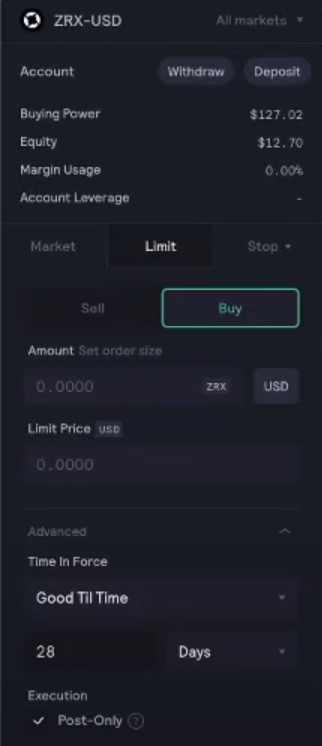
Dydx supports the tools expected by traders who already think in terms of entries, exits, and risk. Market and limit orders cover basic execution. Conditional orders help define exits before a position moves against the account. Charting, order book depth, trade history, open positions, funding data, and account equity sit close to the trading ticket because they affect every decision.
Teams and systematic traders use API access for automated strategies, monitoring, market making, reporting, and execution controls. That does not make the venue only for professionals, but the product language clearly targets users who want more than a swap button. A beginner must learn margin, liquidation, and funding before using leverage because those mechanics drive the account outcome.
Buying power, funding, and liquidation risk
Up to 50x buying power means a trader controls a position larger than the collateral posted for it. A small price move then has a larger effect on account equity. Leverage magnifies gains and losses through the same mechanism, so position size is the real risk dial. The liquidation price matters more than the headline multiple because it shows how far the market moves before collateral no longer supports the position.
Funding payments keep perpetual prices aligned with spot market prices. When demand leans strongly long or short, one side pays the other at recurring intervals. The payment direction and size change with market conditions, so a position that looks profitable on price alone still needs funding included in the cost calculation. Dydx displays these figures inside the trading experience so they become part of the position plan.
Deposits connect major networks to one trading account
Getting started begins with a supported wallet and collateral movement into the trading account. The current experience emphasizes deposits from major ecosystems including Ethereum, Base, Arbitrum, Polygon, Avalanche, and Optimism. That multi-chain deposit flow is important because many traders hold assets across rollups and networks before moving collateral into a derivatives venue.
Once funds arrive, the user chooses a market, checks liquidity, reviews the funding rate, selects order type, and sets size. The cleanest first trade is small, unlevered or lightly levered, and paired with a predefined exit. The goal is to understand how margin, fees, funding, and order execution appear on screen before scaling into larger positions.
Liquidity comes from markets, incentives, and vault design
Deep liquidity is one of the main reasons perpetual traders choose a venue. Tight spreads and stronger depth reduce the cost of entering and exiting positions, especially on large orders. The exchange reports hundreds of listed markets, significant lifetime volume, and open interest across active contracts, which shows that the product is built around scale rather than occasional derivatives access.
MegaVault is part of the liquidity story. It routes deposited liquidity toward market-making strategies and connects passive capital with trading demand. The exact return changes with activity and risk, but the purpose is clear: improve liquidity across markets while creating a structured way for capital providers to participate in exchange activity.
Fees, rewards, and affiliate economics
Trading costs include maker and taker fees, possible promotional fee reductions, funding payments, spread, and slippage. A maker order adds liquidity to the book; a taker order removes available liquidity. Fee tiers and campaigns change over time, so the trading screen and fee schedule matter before placing size. Zero-fee campaigns for specific markets such as BTC or BONK belong in that promotional bucket.
Rewards and affiliate programs add another economic layer. The platform has promoted trading incentives, referral rewards, and affiliate revenue shares tied to volume. Those programs serve a different purpose from core execution: they encourage growth, market participation, and community distribution. They should be treated as variable incentives rather than the foundation of a trading plan.
Where it fits beside centralized futures exchanges
On a practical level, Dydx competes most directly with crypto futures venues that offer perpetual contracts, leverage, fast execution, and many markets. Its distinguishing point is self-custodied DeFi infrastructure. A centralized exchange controls the account system and custody model; this protocol gives traders direct wallet-based access to a derivatives venue while preserving many familiar professional trading features.
That tradeoff changes responsibility. Account recovery, wallet security, collateral transfers, and transaction signing sit closer to the user. In return, the trader gains a transparent on-chain environment, DeFi-native governance, and access without the same account structure used by traditional centralized futures platforms. The best fit is a user who values self-custody and still wants an order book trading experience.
When this exchange is the right tool
The platform is strongest for directional crypto trades, hedge positions, active market monitoring, and systematic execution across perpetual markets. A BTC holder can hedge downside with a short contract. An ETH trader can express a view without selling spot holdings. A strategy desk can connect through APIs and manage many orders with programmatic controls.
It is a poor fit for someone who wants simple long-term holding, card purchases, NFT collecting, or casual token swaps. The product is intentionally built around derivatives, collateral, and execution precision. Dydx makes the most sense when the user already understands price risk and wants a self-custodied venue for crypto perpetuals.
Dydx: questions and answers
What fees should traders expect on Dydx?
Trading cost comes from maker or taker fees, spread, slippage, and funding payments on open perpetual positions. Maker orders add liquidity to the book, while taker orders execute against existing depth. Promotions reduce fees on selected markets during campaign periods, but funding and execution quality still affect the real cost of a trade.
Does Dydx require a centralized exchange account?
No centralized exchange account is needed for the self-custodied trading flow. A user connects a compatible wallet, deposits supported collateral, and signs the required actions from that wallet. The experience still requires careful wallet security because access to the wallet controls the ability to manage funds and positions.
Can beginners use Dydx for their first crypto trade?
A beginner can open the app and learn the interface, but perpetual contracts are more complex than a simple spot trade. The first concepts to understand are collateral, leverage, funding, liquidation price, and order types. Starting with small size and low leverage makes the mechanics visible without turning every price move into an account-level event.
Which wallets and networks work with Dydx deposits?
The deposit experience supports major crypto networks such as Ethereum, Base, Arbitrum, Polygon, Avalanche, and Optimism. A compatible wallet is used to move funds from those ecosystems into the trading account. Network support and asset support are separate details, so the chosen chain and collateral type both matter before initiating a transfer.
What happens if a Dydx position reaches liquidation?
When account equity no longer supports an open leveraged position, the protocol closes or reduces the position according to its liquidation rules. The trader loses the margin assigned to that risk before losing unrelated spot holdings in a separate wallet. Watching the liquidation price, collateral balance, and position size is essential during volatile markets.
Is the DYDX token used only for trading fees?
DYDX is broader than a fee token. It is tied to the network's governance and staking structure, and it participates in the economics around the trading protocol. Traders do not need to treat the token as a requirement for every action, but it is part of how the broader ecosystem coordinates incentives and protocol decisions.