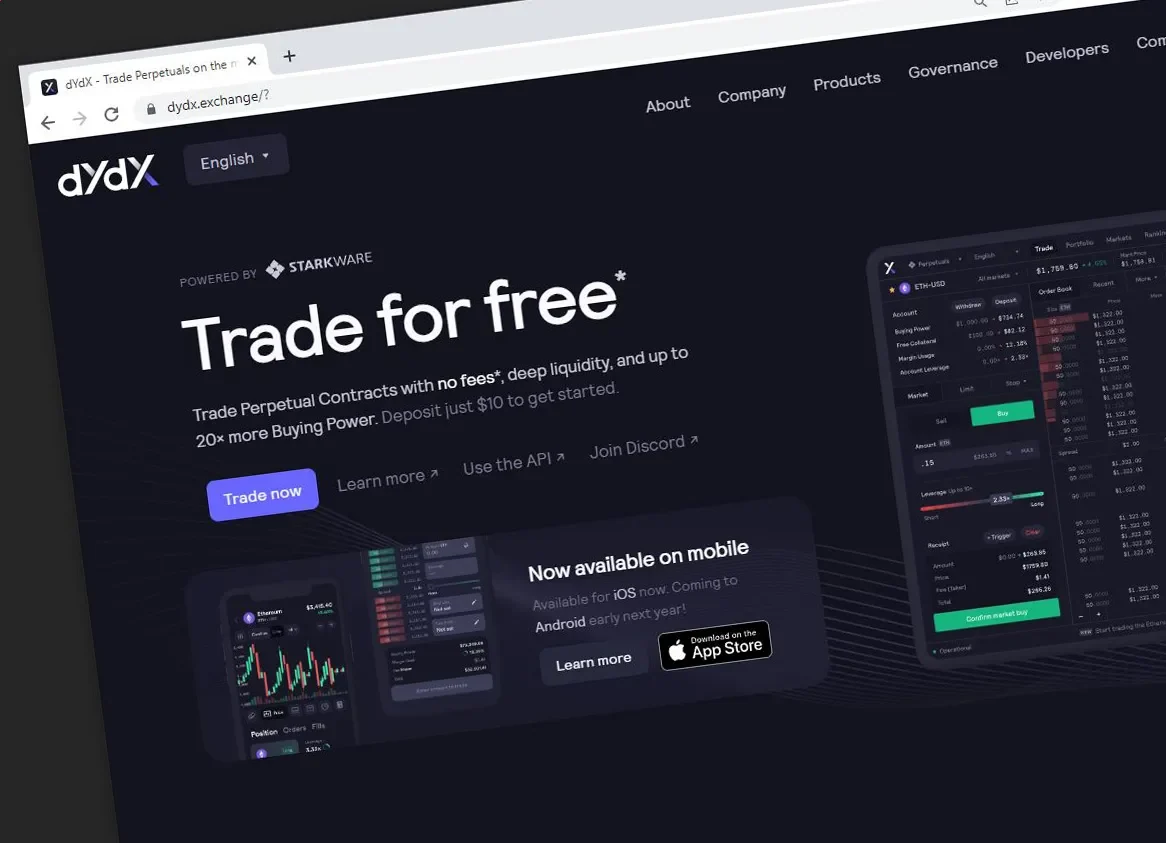
Dydx exchange is a self-custody perpetuals venue for professional crypto markets
In short: Decentralized perpetuals trading platform for self-custody crypto derivatives, with up to 50x buying power across web and mobile.
Dydx exchange is a self-custody perpetuals venue where traders use crypto collateral to take long or short exposure across 200+ markets, with advanced order types, deep liquidity, mobile and web access, and up to 50x buying power. It is built for derivatives rather than simple spot swaps: positions reference assets like BTC, ETH, SOL, and other listed markets while settlement, margin, rewards, and risk controls happen through the protocol experience.
The product is built around perpetual contracts, not spot swaps
A perpetual contract tracks the price of an underlying asset without requiring a dated expiry. Traders post collateral, choose long or short direction, set position size, and manage margin while funding payments keep the contract price aligned with the index price. That structure makes Dydx exchange closer to a derivatives trading desk than a token-swap screen.
Because the focus is perps, the interface highlights order books, leverage, liquidation prices, open interest, unrealized profit and loss, and account equity. Market orders serve fast entries, limit orders set price conditions, and reduce-only controls help close positions without accidentally adding exposure. These details matter because leverage magnifies both gains and losses.
Where self-custody changes the trading workflow
Self-custody means the trader controls wallet access and signs actions rather than depositing funds into a centralized account balance. The platform connects that wallet-based flow to a trading interface with the speed and layout expected from active markets. Dydx exchange keeps the familiar components of professional trading while placing account control closer to the user.
Deposits are designed to move value into the trading environment from major networks such as Ethereum, Base, Arbitrum, Polygon, Avalanche, and Optimism. Once funds are available, the trader manages margin, opens positions, and withdraws through the app experience. The private key or wallet recovery method remains the critical access point for the account.
Markets, buying power, and the role of collateral
The main appeal is breadth: 200+ markets give traders exposure to large-cap crypto pairs, newer listings, and more specialized assets without needing to hold every underlying token. Buying power up to 50x means a smaller collateral amount controls a larger notional position. High leverage also narrows the distance between entry price and liquidation, so position sizing matters as much as market direction.
Collateral supports open positions and absorbs unrealized losses. When price moves against a position, margin ratio falls; when it moves in favor, equity rises. The platform displays liquidation information so a trader sees the price zone where insufficient collateral forces a close. Funding rates, fees , and price impact belong in every trade plan because they change the true break-even level.
Orders and tools that active traders expect
Dydx exchange includes advanced order types and a trading layout built for fast decision-making. A trader working a breakout watches the order book and depth, places a limit order near a level, adds stop logic, and tracks fills from the same workspace. Teams and algorithmic users also look for API access because systematic execution needs reliable order submission and account data.
The mobile app extends that workflow for monitoring and adjustments away from a desktop. The web interface remains the fuller command center for charting, market scanning, and risk review. Together, the two access points support both discretionary traders and more structured strategies.
Fees, incentives, and liquidity sources
Trading costs come from the fee schedule, spread, funding, and market impact. The official messaging emphasizes low fees and promotional zero-fee periods for selected markets such as BTC and BONK during specific campaigns, but the durable habit is to read the live fee table before sizing a trade. Maker and taker economics matter most when a strategy turns over positions frequently.
Liquidity is another core part of the experience. Deep liquidity reduces slippage on larger orders and supports cleaner entries during volatile periods. MegaVault is part of the product set around protocol liquidity, while affiliate and reward programs add incentives for trading activity, referrals, and long-term ecosystem participation. Rewards improve economics only when the underlying trade still makes sense on its own.
How a first trade comes together
Getting started is a sequence of account setup, funding, market selection, and risk sizing. A practical first session on Dydx exchange begins with a small collateral transfer, a familiar market such as BTC or ETH, and a low-leverage order that makes the mechanics clear before larger exposure enters the account.
- Connect a supported wallet and complete the app's account setup flow.
- Deposit collateral from a supported network into the trading environment.
- Choose a market and review index price, order book depth, funding, and open interest.
- Set direction, leverage, order type, and reduce-only or stop conditions.
- Monitor margin, liquidation price, funding payments, and realized profit or loss after the trade fills.
This sequence turns the interface from a wall of numbers into a repeatable workflow. The first objective is understanding how collateral, position size, and liquidation distance interact. After that, charting, order placement, and execution style become easier to evaluate.
DYDX, governance, and the wider protocol economy
The DYDX token is tied to the broader dYdX ecosystem, including governance and incentive design. Token holders participate in protocol direction through governance processes, while trading rewards and affiliate programs connect usage to ecosystem distribution. Those mechanics make the exchange more than a standalone front end; it is part of a DeFi network built around derivatives liquidity.
Governance does not remove trading risk, and token rewards do not replace disciplined margin management. They add an economic layer around the marketplace. Traders who care about protocol alignment, decentralization, and community control pay attention to how incentives shape volume, liquidity, and long-term participation.
When it fits better than a centralized futures account
Notably, Dydx exchange fits traders who want perpetual exposure with wallet-based control, transparent onchain settlement architecture, and a familiar professional interface. It is especially relevant for crypto-native users who already manage wallets across Layer 2 networks and want to avoid moving every trade through a centralized derivatives account.
Centralized exchanges still compete on fiat ramps, bundled account services, and support flows. Other decentralized derivatives venues compete on chain choice, liquidity design, fee models, and listing speed. GMX, Hyperliquid, Drift, and Vertex all approach perps with different market structures, so the right venue is the one whose liquidity, collateral flow, and execution style match the trade being placed.
The main risks are margin, volatility, and execution discipline
Perpetuals create direct exposure to fast price moves, and leverage compresses the time available to respond. Liquidation, funding shifts, thin order books in smaller markets, wallet access errors, and bridge or deposit delays all affect outcomes. Dydx exchange gives traders the data needed to act, but the account owner still chooses leverage, collateral, stops, and whether a trade is worth taking.
The cleanest use of the platform is deliberate: trade markets you understand, use order types intentionally, leave room between entry and liquidation, and treat rewards as secondary. That approach makes the product's strengths more useful: broad market access, self-custody, professional tooling, and a DeFi-native structure for leveraged crypto exposure.
What to know about Dydx exchange
What collateral do I use for trading on Dydx exchange?
Dydx exchange uses crypto collateral inside its trading environment, with deposits routed from supported networks such as Ethereum, Base, Arbitrum, Polygon, Avalanche, and Optimism. The exact asset and network choices appear in the app during deposit. Collateral supports margin for open perpetual positions, so available equity changes as trades gain or lose value.
Does Dydx exchange support spot buying of tokens?
Dydx exchange is centered on perpetual contracts rather than ordinary spot purchases. A perp position gives price exposure to an asset without delivering that asset into the wallet. Someone who wants to own BTC, ETH, or another token outright uses a spot exchange or swap venue; someone who wants long or short derivatives exposure uses the perps workflow.
Can I trade on Dydx exchange from a phone?
Yes. The platform offers both web and mobile access, so traders use the desktop interface for detailed charting and the mobile app for monitoring, order management, and position adjustments. Mobile access is useful for active positions because liquidation price, margin level, funding, and profit or loss can change quickly during volatile sessions.
Which order types matter most for a new perps trader?
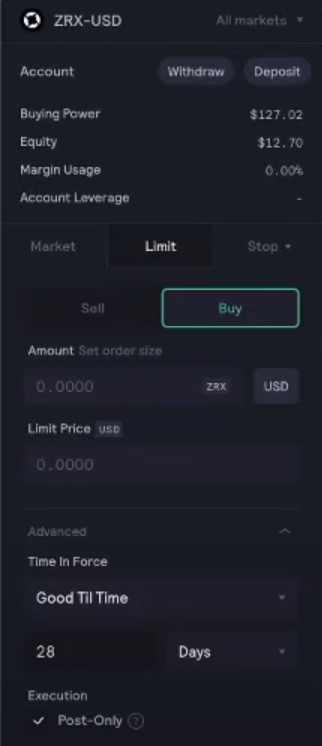
Limit orders, market orders, stop-style risk controls, and reduce-only instructions matter first. A market order prioritizes execution speed, while a limit order controls entry price. Reduce-only is important when closing or trimming a position because it prevents the order from increasing exposure by mistake. These controls make leveraged trading more precise.
Fees on Dydx exchange: what affects the real trading cost?
The real cost comes from the posted fee schedule, spread, slippage, funding payments, and any market impact from order size. Promotional zero-fee campaigns for selected pairs reduce one part of that cost for a limited period, but funding and execution quality still matter. High-turnover strategies feel these costs more than occasional position trades.
Why does funding matter on a perpetual position?
Funding keeps a perpetual contract aligned with its index price by transferring payments between long and short sides. When funding is positive, one side pays the other; when it turns negative, the flow reverses. A trade that looks profitable on price movement alone can become less attractive if funding remains costly for the position's direction.